Thursday, December 4, 2008

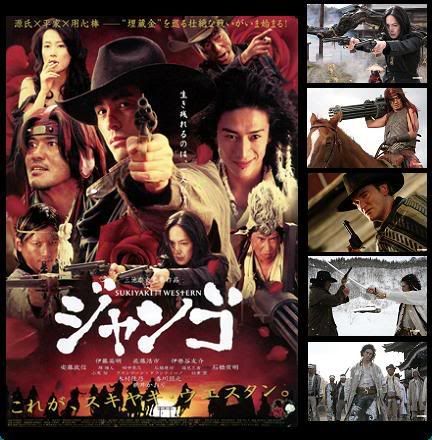
Sukiyaki Western Django

A little over two months ago I sent an email to my brother with the subject line "AWESOME!!!" The actual content of the email included a lewd joke that I won't reprint here, but the point was that I was excited. I have just found out that Takashi Miike (Audition, Dead or Alive, Ichi The Killer) was coming out with a new movie, an homage to the spaghetti Westerns of yore, called Sukiyaki Western Django. And as if the prospect of a new Miike movie wasn't exciting enough, or the fact that it was going to be a spaghetti Western, I saw the trailer:


I mean, really, how fucking bad-ass does that look? Pretty fucking bad-ass, right?

I was really looking forward to this. Miike elicits visceral reactions from me in ways very few directors can. Years of gorging myself on horror movies left me feeling like there was little in the way of graphic violence that could really shock me (see my review of the booooooring Hostel), but then I saw Miike's Ichi The Killer. The movie is insane, awesome, and crazy as all hell in a number of ways. It is thoroughly fucked up. In fact, here is a trailer for the DVD release (be warned, even the trailer is pretty graphic and NSFW):


That only gives you a small idea the craziness in that movie. It's that and so much more. Plus, as anyone who has seen Audition can attest, Miike can not only do balls-out crazy, but he can do creepy, eerie, and disturbing in much more subtle ways (not that Audition is overly subtle, especially by the end). Anyways, in short, the guy knows how to make some fantastic movies, and I'm on board with anything he's doing.

And what was he doing this time? Making an ode to the old spaghetti Westerns. If you think you don't like Westerns, do yourself a favor and rent The Good, The Bad, and The Ugly or The Wild Bunch or Django (which this film is apparently meant to be a prequel to, and which I still have yet to see, so take that last recommendation with a grain of salt). In short, I dig Miike and I dig spaghetti Westerns. Perfect pairing, right?

Well, not exactly. I watched Sukiyaki Western Django a few weeks ago. Overall, I was kind of disappointed. Inflated expectations definitely had something to do with it. I was so excited for this movie, there really is no way for me to not be at least a little disappointed. But in reality, expectations aside, the movie was only pretty good. There are definitely great things about it, but there are also plenty of things that are less than great.

The action is amazing. There are a lot of crazy gun fights, some fun sword play, all kinds of explosions, and quite a few crossbows. Aside from all the action sequences, the film is also filled with Miike's bizarre sense of humor (the character of the Sheriff is particularly funny in a very Miike-way). The problem is that the film is pretty back-loaded, just about all of the excitement comes in the second half of the film. Which wouldn't be a problem, if it weren't for the first half of the film.

The first half isn't bad, just slow and kind of incomprehensible. The entire cast is made up of Asian actors all speaking English, with accents of varying degrees of thickness (kind of a cool idea, but also kind of frustrating). The exception being Quentin Tarantino, who I know for a fact can speak fluent English, but still felt the need to speak with some kind of bizarre made-up accent. The first half of the film is spent setting the story, which was difficult to follow in part because a lot of the actors are hard to understand (Tarantino and his bizarro-accent included) and in part because the story was just confusing.

Essentially, the story revolves around a small frontier town in Nevada. During the gold rush, rumors would spread throughout the West that certain towns had secret caches of gold, and inevitably gangs of prospectors and thugs would descend on said town to steal away the gold. As had happened to so many towns before, word spread that this town had its own secret gold stash. Eventually the violent Heiki clan ("Red") came to town and began bleeding the town dry as they searched in vain for a treasure that may or may not exist. Shortly thereafter the rival Genji clan ("White") also come to town, looking for the same treasure. A race to find the gold, combined with an ongoing war between the clans, effectively destroys the town. (The rival clans were lifted directly from Japanese history, FYI)

The movie begins at this point, as a lone gunslinger comes to town looking to get rich. He offers his services to the highest bidder, and quickly joins the Genji clan. Inevitability deceptions and betrayals set off a full on gang-war that threatens to consume what remains of the town, all on the eve of the delivery of a special weapon guaranteed to tip the scales in the Genji's favor. As the gang-war escalates, the gunslinger begins to align himself not with either gang, but with the few remaining residents of the town, comprised almost entirely of the proprietor of the local saloon, her granddaughter, and her loyal employee, and discovers an improbable link between the two warring clans. It is about this point that the full-on crazy action starts.

As I said, I was a little disappointed. I think that this movie, in reality, is probably somewhere between pretty good and kind of great, but it just fell short of expectations. The movie is definitely entertaining, don't get me wrong. If you like Westerns or Miike, and are looking for an entertaining way to spend a couple of hours, you could certainly do a lot worse than Sukiyaki Western Django. I think I may have shot myself in the foot with my crazy expectations. As long as you go in anticipating an entertaining but not great movie, I think you'll be satisfied. And if you have the stomach for it, watch more Miike.

Wednesday, December 3, 2008

“They’re taking our children away”

So, I had mentioned in my previous post that while watching The Sweet Hereafter I noticed a bizarre connection between that movie and the song "They Don't Want Your Corn, They Want Your Kids" by Liars. Well, I said I'd post another entry about it, and here it is.

Some of the things I am going to cover regarding the movie involve some plot points that may not ruin the movie per se, but will definitely give some stuff away. So consider this your spoiler alert. If you're interested in watching The Sweet Hereafter (which I would recommend), I might hold off on reading this.

***Spoilers Start***

As I was watching the movie, I kept hearing bits of dialogue that sounded vaguely familiar. By about the third time this happened, I realized that all these lines in the movie were also lyrics in the aforementioned Liars song "They Don't Want Your Corn, They Want Your Kids". After I realized this, I picked up on a few more lines of dialogue that are also lyrics. Most of the time, the lyrics aren't exact quotes from the movie, but are practically identical. Here is an example:

In one scene, Sarah Polley's character is reading "The Pied Piper" by Robert Browning to two children, and this becomes a reoccurring theme throughout the movie, her character providing voiceover in multiple scenes as she continues to read the poem. The poem includes the lines:

Fathers, mothers, uncles, cousins

Cocking tails and pricking whiskers

Families by tens and dozens

Brothers, sisters, husbands, wives

Followed the Piper for their lives

This is actually what brought this to my attention. The Liars song contains the lines:

Fathers, mothers, uncles, cousins

Families by tens and dozens

Brothers, sisters, husbands, wives

All of them fighting for their lives

Again, not an exact quote, but pretty close (actually, I'm not entirely sure about that last line, but it's close enough). Now, I realize that it seems perfectly reasonable that Liars took their lyrics from the original Browning poem rather than the movie. Which is more or less what I thought, but it kept happening. Here is another example. The character of Mitchell Stevens is talking on the phone to his runaway drug addicted daughter, Zoe. They have the following exchange:

Mitchell: Tell me your news, Zoe.

Zoe: OK. Yesterday I went to sell my blood. I'm in this fucking city, and I'm selling my blood.

Mitchell: That's not news, Zoe.

Zoe: No, but this is. They wouldn't take my blood. Do you know what that means, Daddy? Does it register? I tested positive. Welcome to hard times, Daddy.

Mitchell: What do you want me to do, Zoe? I'll do whatever you want.

Zoe: I need money.

Mitchell: What for?

Zoe: No, you cannot ask me that! Not anymore! You asked me what I wanted, not what I wanted it for. I want money.

Mitchell: Do you have a blood test?

Zoe: You don't believe me? You don't fucking believe me?! I like it when you don't believe me. It's better that you don't believe me, but have to act like you do.

[Both are quiet]

Zoe: I can hear you breathing

Mitchell: I can hear you breathing, too.

[Zoe hangs up phone, Mitchell continues to whisper into the now dead line]

Mitchell: I love you, Zoe. I'll take care of you. I'll take care of you.

Pretty intense, right? Well here are the lines from "They Don't Want Your Corn, They Want Your Kids" sung in a back-and-forth call-and-response style:

Mama, I'm selling my blood

Welcome to hard times

Daddy, I can hear you breathing

I'll take care of you

I'll take care of you

And finally, one last example that I noticed. When Mitchell is trying to convince one of the parents to join the lawsuit, and the parent refuses, Mitchell explains that his daughter is a drug addict. That everyone is losing their children, if it isn't bus accidents, it's drugs. If it isn't drugs, it's any number of other horrible things that destroy our children's lives. He concludes by saying:

Something's happening that's taking our children away.

In the song, the four lines quoted above ("Mama, I'm selling my blood…") are followed with the repeated phrase:

They're taking our children away

I'll take care of you

They're taking our children away

***Spoilers End***

I want to make it clear, it's not like the entire song is somehow lifted from the movie. There are just some lyrics that are obviously inspired by (or taken from) the movie. More than anything, this just seemed extremely bizarre. Buried in the middle of a dense and strange concept album about German witch folklore is a song seemingly inspired by an independent Canadian film from 1997 (that has absolutely nothing to do with witches, mind you). I've just been trying to wrap my mind about what a strange and totally unexpected pairing this is.

Regardless, both the song and movie are amazing. I'd highly recommend seeing The Sweet Hereafter (check out my entry about it to see if it sounds up your alley). I also absolutely love the song "They Don't Want Your Corn, They Want Your Kids." In fact, I love everything Liars do, and They Were Wrong, So We Drowned is definitely my favorite album. It's a strange, dense, ugly album, so it's not for everyone. But it's one of my favorites.

[Note: I totally had the quotes formatting really nicely in Word, then the formatting got all screwed up when I uploaded the post. Sorry about that.]

“No, not mean. Just very angry.”


After being thoroughly taken in by Atom Egoyan's Exotica, I bumped another of his movies to the top of my Netflix queue, The Sweet Hereafter.

Egoyan's The Sweet Hereafter (an adaptation of the novel of the same name by Russell Banks) tells the story of how a tragic school bus accident forever changes a small mountain town, and how easily the grieving process can be disrupted and distorted. Following a school bus accident that takes the lives of over 20 children, a lawyer named Mitchell Stevens (Ian Holm) arrives in town, intent on initiating a law suit. As he works his way through family after family, his presence confuses the town and disrupts its ability to deal with the tragedy. The mettle of all involved, including Stevens, is called into question as the impending lawsuit drives a schism through the already fractured town.

The premise of a lawyer exploiting the deaths of children sounds like it could easily have been unwatchably depressing, yet The Sweet Hereafter has less a feeling of crushing depression than a feeling of exhausted resignation. It is definitely sad, but never exploitative or melodramatic. The town, in its state of perpetual shock, seems coldly calm as anger, blame, confusion, pain, and loss all simmer below the surface. There are no grand scenes or gestures, but simply a town full of people, who all know each other, trust each other, who are all trying to deal quietly with the same personal and shared tragedy.

Egoyan dismantles the narrative and weaves it back together into a single coherent tapestry, painting a broad portrait of the town and its people. Even though scenes jump back and forth in time, the story never seems disjointed, flashbacks to known and unknown times flow coherently in and out of the ongoing story. The viewer is ultimately given not just a story, but a panoramic understanding of the characters and the small world they inhabit. Matching the broad narrative, the film is filled with stunning, beautiful photography of the small snowy mountain town. Large skies and monstrous snow-capped mountains fill the frame, giving the town a harsh and natural beauty, making the town look so small and isolated in an intimidatingly large world.

The acting is fantastic throughout. Be it Ian Holm as the lawyer whose motivation has less and less to do with money, the bus driver who must deal with the knowledge that she was behind the wheel when the bus crashed, or any number of the parents dealing with the death of their children. An eighteen year old Sarah Polley deserves special recognition as the lone child to survive the crash. She delivers a subtle and nuanced portrayal of a girl whose world is thoroughly and irreversibly changed.

The film is beautiful and powerful, but never melodramatic or exploitative. The story is twisted, subtle, and confusing, but never frustrating. Just as in life, there are no clear motivations, no good guys or bad guys, no complete resolutions. Everything moves forward, for better or worse, one day at a time. No faster, no slower.

Just as with Exotica, at the end of the film, I was left thinking about The Sweet Hereafter long after it was finished. I went to bed thinking about it and resuming thinking about it as soon as I woke up. If all of Egoyan's films are this deeply affecting, I am more than willing to dive completely into his filmography. I think I liked Exotica better, but acknowledge that The Sweet Hereafter was probably a better movie. But really, it doesn't matter, they were both amazing films, and both deserve to be watched.

[Note: I noticed a bizarre connection between this film and the Liars' song "They Don't Want Your Corn – They Want Your Kids" off of They Were Wrong, So We Drowned. I plan on writing up a brief entry on this soon, so look out.]

Wednesday, November 26, 2008

Groovy Automotive – Another Awesome Austin Legacy

As I had mentioned a few posts back, I had some problems with my car's brakes. Specifically, they didn't work. At all. Well, I got them fixed recently, and just wanted to spread word about another great part about Austin – Groovy Automotive.

Now, Groovy isn't a hold-over from hippy-era Austin. In fact, according to their website, they've only been around since 1993 or something (despite their multi-colored neon sign with the Peace Signs for "o"s), but that doesn't change the fact that they're fantastic. Not only the best auto shop I've been to in Austin, but they are easily the best I've been to anywhere. Cheap. Quick. Trustworthy (they have never tried to fix anything that I didn't explicitly tell them I needed fixed). Courteous. Accommodating. All-in-all, just about the best experience I could expect to have while dealing with one of the shittiest of all errands (god, I hate car troubles).

Really, I just wanted to give Groovy their due as a fantastic mechanic's shop. I can't begin to explain how frustrating I find dealing with car troubles (it doesn't help that I know absolutely nothing about cars), and what a foul mood it puts me in. So to take care of something as serious as brakes that don't work (and they didn't work at all) with so little headache is nothing short of a small miracle.

In the unlikely event that you ever find yourself in Austin with car troubles and don't know where to go, trust me. Go to Groovy.

Sunday, November 16, 2008

G-String’d Cyclist: The Musical

This afternoon I momentarily stepped out of my cave-like studio apartment, and ventured into the harsh Texas sun. As I stood next to my apartment building, I saw a heavyset guy cruise by on a recumbent bike, complete with little-kid-style flag sticking up out of the back wheel. As I watched this guy, amazed that his bike was able to stay upright despite his almost unbelievably slow speed, I was greeted with an even better sight. Just as the first guy passed out of view, heading west, another bicyclist entered my view heading east. This guy was on a regular bicycle, and was moving at normal speed. So what made him awesome, you ask? Well, how about the fact that it was a full grown man, riding his bicycle through my neighborhood, in the middle of a pleasant Sunday afternoon, wearing nothing but a green G-string.

A full grown man. On a bicycle. Riding down the street. In the middle of the day. In nothing but a G-string. Just a G-string.

Not only was this event totally fucking awesome, but it also got me thinking. Not so much about men in G-strings. I mean, I already got to see that today. But more about the character of Austin. While this bicyclist was definitely a noteworthy event (as soon as I went inside, I called my brother to tell him about it – after which he provided this post's title), it's not completely unprecedented. I want to be clear, I'm not a long-time Austinite. I've only been here for about 2 ½ years, and I am not even from Texas (Michigan, what!). So this is all based on my somewhat limited experience in Austin and definitely limited knowledge of Austin history.

Back in the 1960s, Austin was the little liberal, counter-cultural oasis for the South and Southwest. A strange, little hippy haven in the big sea of the conservative south. Over the years, Austin's hippy, counter-cultural past has evolved, leaving an indelible mark all over the city. There is the legendary music scene. The well-respected independent film industry. The abundant art galleries. The numerous experimental theaters. The murals that adorn the side of just about every building. The love of local business, organic food, etc.

And then there are some things that seemingly haven't changed all that much over the years. Hippies are still plentiful. There are a bunch of communes all over the city. There is the nude beach, Hippy Hollow. Apparently a lot of those experimental theaters do weird nude fertility plays. And then there's probably my favorite legacy of Austin's hippy past. The fact that, of all the hippy-type stuff to stick around, one thing that is still going strong in Austin is the good ol' fashioned hippy freak out.

Now, I guess I shouldn't say that these freak outs haven't gone unchanged. They aren't full blown Merry Pranksters-style happenings. More like individual expressions of personal weirdness. They may be a little more self-conscious than simple free expression (there is the ubiquitous "Keep Austin Weird" campaign, after all), but that doesn't make them any less enjoyable. The fact that at any moment you can come across something like a guy riding a bike in a G-string really lends the city a certain playful whimsy.

On top of the G-string'd Cyclist, there was the guy last year who hung out in my neighborhood, dressed in flamboyant clothing and a rainbow afro, dancing on street corners while holding a sign that read, "In the future, you will all look like me." There is Leslie, the city's favorite transvestite homeless guy/girl/perennial mayoral candidate (see picture). Actually, Austin has no shortage of transvestite homeless people, a special little subgenre of Austin weirdness. A friend of mine went to the post office downtown, and the man in line in front of her was inexplicably wearing a Superman costume. On the University of Texas' campus, a cadre of students have taken to riding giant unicycles around.

My G-string'd Cyclist induced musings didn't really lead to any grand conclusions, simply a conscious appreciation for the city of Austin. Sometimes I forget how great of a city Austin Is, and it's nice to have a people around who are willing to ride by my apartment in skimpy underwear to remind me of that.

[Note: After leaving a voicemail for my brother about the G-stringed cyclist he responded with the following series of text messages: "G-String'd Cyclist: The Musical", "starring Josh Hartnett", "and Jamie Lee Curtis", "Christmas 2009". Screenplay is in development, and I am currently in talks with Philip Glass to compose the music, with lyrics by Rod Stewart.]

“Well, I’m not gonna get another [body], so I’m gonna use this one until it’s all used up.”


Bob Flanagan was born in 1952, and shortly thereafter was diagnosed with Cystic Fibrosis. Ordinarily, Cystic Fibrosis, a genetic disease that causes the lungs to fill up with thick mucus, kills those who have it by the time they are 6 or 7 years old. Sometimes, suffers of CF live into their early 20s before dying, usually of a lung infection. Flanagan lived to be 43, gaining notoriety for his writing and performance art that focused on his pain and struggle with his disease, often through public demonstrations of extreme self-mutilation.

Documentarian Kirby Dick chronicles Flanagan's final years in his film Sick: The Life & Death of Bob Flanagan, Supermasochist. True to the title, the film follows Flanagan, as well as his long time partner/Mistress Sheree Rose, starting in his early 40s right up through his death in late January, 1996. Sick sheds light on the many aspects of Flanagan's life: his art, his relationship with Rose, the anger and humor he directs at his disease. Flanagan makes for a fascinating figure, be it because of his controversial art or his particularly unique perspective on life. One can't help but have a unique perspective on things when you've lived your entire life being told you're going to die and, by all accounts, you should already be dead. But you're not. (In Flanagan's own words, "All the articles about me start the same way, 'Bob Flanagan should be dead by now. But he isn't.' That's what they always say. 'Instead he nails his dick to a board.'")

In case that last comment about nailing his dick to a board or the term "Supermasochist" didn't clue you in, Flanagan made his name in the art world for his acts of extreme self-mutilation. These acts of supermasochism included, but were not limited to, hammering a nail through his penis into a wooden board, suspending himself upside down from the ceiling of art galleries, being physically abused in just about every conceivable manner, often accompanied by Flanagan's darkly comic monologues about living with CF. The film presents plenty of examples of Flanagan's performances, so be warned, this film is extremely graphic. So if you don't think you can handle watching a close-up of a nail being driven through the head of penis, near constant spanking, frequent cutting, and at least one instance of on-camera sodomy, you should probably stay away.

The film generally focuses on two aspects of Flanagan's of life: how his proclivities for BDSM, both in his art and in his bedroom, gives him a sense of control over his body, a body that refuses to function properly; and the intimate and trusting relationship he has with his longtime partner Sheree Rose. These two elements are, realistically, inseparable. Rose was not only Flanagan's SM Mistress, but also his partner in life and art. The trust and intimacy that is inherent in such a long term BDSM relationship is on full display. The film does not shy away from showing the couple's extreme intimacy, whether it is through homemade videos of their SM adventures or through quiet conversations in bed. It is apparent that there is a closeness, an intimacy, and a trust between the two of them that is rarely found in the most functional of relationships.

In terms of Flanagan's art, the film explores how Flanagan views his masochism and his self-mutilation as a way for him to reclaim control over a body that refuses to function as it should. His explorations of the limits of what he can endure forces him to engage with his body in a way that gives him a fuller understanding of his physical self, as well as teaches his body what it is capable of, despite its disease. It is as much about his own self discovery as it is about confronting audiences with shocking experiences. It is about bringing the audience into Flanagan's own experiences with his disease (including one art gallery exhibition of his work, a part of which included Flanagan sitting in a hospital bed, in the gallery, throughout the duration of the exhibition, allowing viewers to see him and talk to him).

Ultimately, Sick: The Life & Death of Bob Flanagan, Supermasochist paints a very intimate portrait of a man who had to learn very young what he wanted and how to take it for himself. Up through the end, in which Dick films Flanagan dying in his hospital bed, Flanagan seems scared and, above all, confused by his own death. Even though he has spent his entire life confronting his own death, he seems just as terrified and confused as anyone else. Sick and its subject are extremely funny, intimate, heartbreaking, and, more than anything else, inspiring.

Saturday, November 15, 2008

"Do you have a lot of friends? [Not really…] Do you wish you did?"


Writer/director Atom Egoyan is one of a host of independent filmmaking luminaries to arise in the 1990s. He has a reputation for making deeply emotional, moody films that delve into the darker and more complex realms of the human condition. And Exotica is no exception.

Broadly, Exotica examines the individual lives of a set of disparate characters, all related in some way to the titular strip club. There is Francis, the IRS (or the Canadian equivalent of the IRS) auditor, who is obsessed with Christina, one of Exotica’s dancers. There is Eric, also obsessed with Christina and her former lover, the DJ/MC at Exotica. There is Zoe, the pregnant owner of Exotica, who has a vested interest in both Christina and Eric, beyond that of employer/employee. And finally, there is Thomas, the reclusive, socially awkward, and lonely gay pet store owner, who is dragged, somewhat unwillingly into Exotica’s world.

The characters are slowly fleshed out, not only through their actions in the present, but through the slow reveal of their individual histories. As the film progresses, we see how each of the individual characters’ stories are deeply entangled with one another, in ways both known and unknown to the characters. I don’t want to get much more into the plot than that. To reveal much more would ruin the impact of the story.

Unlike films such as Crash (the racism one, not Cronenberg’s auto accident fetishism one) or the films of González Iñárritu (Amores Perros, 21 Grams, Babel), the interweaving story lines of Exotica are not the result of grand spectacular events (car crashes seem to be a popular one). In fact, with one exception, none of the relationships in the film take place during the film, the vast majority are revealed slowly through flashbacks and characters’ histories. Egoyan paints a vivid world that by the end seems so small, so claustrophobic, that it is not only natural that these characters’ lives have tangled themselves up with one another, it would be almost unbelievable if they hadn’t.

It is a testament to Egoyan’s story telling ability that he takes a concept (the interweaving storylines of seemingly unrelated characters) that is so inherently contrived, and manages to tell a story that is so naturally convincing. Rather than spectacular, sensational events, Egoyan reminds us that all of our lives are naturally tied to the lives of all those around us, either in profound ways, or ways so subtle that we are totally unaware of them.

Upon finishing the movie, I remember thinking something along the lines of “oh, well, that was pretty good,” but I’ve been thinking about it for days. The more I think about it, the more I realize how good it was. The story is so well constructed and so subtly presented, that the more I reflect on it, the more I grow to really appreciate how good it was. I’m actually pretty disappointed that I sent it back to Netflix the next day, rather than watch one or two more times. It’s the kind of film that gets under my skin, and now I can’t stop thinking about it.

I would highly, highly recommend Exotica. It is a gloomy, moody, beautifully told story of how all life experiences, good, bad, and heartbreaking, impact everyone who comes in contact with it. Reminding us that all aspects of life are extremely fragile and their fallout contagious, spreading far and wide.