Sunday, November 9, 2008

"I'm not a preacher and I'm not drunk. I'm a politician."

In 1962, character actor Timothy Carey released his labor of love, The World’s Greatest Sinner, which he wrote, produced, directed, and starred in. It took Carey four years to bring his vision to life, creating a bizarre, blasphemous, surreal cult masterpiece.

The World’s Greatest Sinner is about an insurance salesman named Clarence Hilliard (Carey), who decides one day that he is completely unfulfilled with his life. He quits his job to form a new political party, proclaiming that the only true God is man. He runs for president on a platform of promising entire life to all of his followers, deeming them “super-beings.” Along the way he starts a rock band, renames himself “God Hilliard,” and manages to incur the full wrath of God.

Think that sounds strange? That doesn’t even begin to describe the bizarre craziness that is The World’s Greatest Sinner.

The movie starts with Clarence Hilliard sitting at his desk at his insurance salesman job. After giving the entire office the day off for no reason, he takes a call from a woman looking to buy some life insurance. He convinces her that life insurance isn’t worth buying since “once you die, your body starts smelling pretty bad. They’ll just bury you for free eventually.” Shortly after this exchange, Clarence’s boss fires him.

Upon his return home, Clarence explains to his wife and daughter that he’s going to write a book. He’s going to change the world. Then he’s going to write another book. He’s going to run for president. He continues to plot out how he’s going to change the world in a manic craze, roping his more than willing gardener into his plan.

That night he goes to a teen dance club, where he witnesses the awesome power that rock’n’roll has over the teenie boppers. He returns that night, declaring that rock’n’roll is the perfect way for him to spread his gospel and gather followers. He and his gardener set out the next day, guitar in hand, to begin preaching on street corners and in vacant lots. Slowly but surely, his message of the supreme power of man, his promise of eternal life, and his unassailable enthusiasm begins winning over more and more followers.

Soon he starts a full rock’n’roll band, touring the country, holding crazed and unruly rock concerts that double as political rallies. As he continues to preach his message, Clarence begins to refer to himself as “God Hilliard,” declaring himself and his followers the only true gods. As his movement continues to gain members and momentum, God Hilliard becomes increasing manic, believing himself to be a true god. He starts seducing all women he comes in contact with, including the elderly and the underage. God even forces a follower who expressed doubt to commit suicide, proclaiming the follower’s doubt a symptom of his weakness, rendering him unfit for the power God would have given him.

God’s “political party” increasingly becomes a cult of personality, taking on tones of fascism as a mysterious, bispectacled campaign manager appears, blatantly feeding God’s delusions. Eventually God Hilliard begins openly challenging the Christian God, daring Him to prove His existence. Ultimately, this leads to a climatic confrontation in which God Hilliard teeters between repentance and full-blown megalomania.

I can honestly say that The World’s Greatest Sinner is one of the most bizarre movies I have ever seen. The premise is strange enough, but as a self-financed, independently filmed movie, shot over a number of years, the movie is imbued a number of surreal qualities. The editing is so bizarre that a scene will change seemingly before the previous scene has had a chance to end. Scenes are edited together in ways that make it difficult for the viewer to understand what is going on spatially (the poor film stock and lighting doesn’t help either). The dialogue is confusing and hard to follow. While all of this may make the film seem amateurish, it also lends it a nightmarish fever-dream quality. You vaguely know what’s going on, but you can’t really nail down specifics, be it what the characters are discussing, where the characters are, or how you got from scene A to scene B.

The movie appears to have been filmed in sequence, as some of these editing and lighting problems lessen as time goes on, suggesting they were figuring out the basics of filmmaking as they went along. As God Hilliard and his movement fly more and more off the rails, the viewing experience gets progressively more accessible. Though it never really obtains a level of normal competence, which is actually a good thing. As straightforward as the filmmaking gets, it maintains its difficult and surreal style throughout.

While The World’s Greatest Sinner takes on serious issues like religion, politics, media manipulation, and the corrupting natural of power, I do want to make it clear that the film is flat-out entertaining throughout. Be it the very strange and strangely powerful musical performances (pre-Mothers of Invention Frank Zappa wrote all the music) or moments of truly laugh out loud humor (a discussion Clarence has with his gardener about whether or not he should grow a goatee to look more like a real leader is fantastic – he compromises and starts wearing a glued on goatee), the movie is thoroughly enjoyable.

I would highly recommend tracking it down if you have any interest in bizarre cult movies, and have a high tolerance for borderline incompetent filmmaking. It is truly a mesmerizing, surreal, hilarious, and confusing viewing experience.

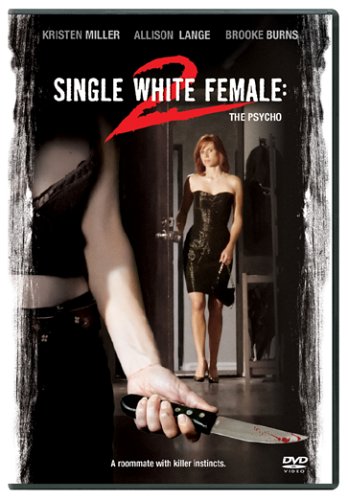
Single White Female v. Single White Female 2: The Psycho – A late night Lifetime Movie Network Showdown


This past Saturday I was supposed to attend a housewarming party at my friend Brencho’s new place. I got in my car and noticed that there was a warning light telling me my parking brake was on. This struck me as odd, seeing as I never use my parking brake. Turns out the light was actually warning me that my brakes didn’t work, because they didn’t. I pretty quickly figured out that my brakes essentially do nothing. After a very short, and somewhat terrifying, drive back home, I decided it would probably be best for everyone if I just stayed home.

Upon getting back to my apartment, it was 11pm on a Saturday and I had to decide what to do with myself. I had a couple of movies from Netflix I could watch. I could do some reading. Maybe spend the night having a few beers and listening to music. Or I could just go to bed at a reasonable time like a normal person. Then I found out that Single White Female was on the Lifetime Movie Network (which as you could probably guess, LMN is a channel that shows Lifetime movies 24 hours a day). I’d never seen Single White Female, and had the impression it was supposed to be a pretty good movie, or at the very least, campy, guilty fun. So Single White Female it was.

Bridget Fonda plays Allison, a beautiful, young, successful urbanite. When Allison discovers her fiancé cheated on her, she kicks him out of the apartment they share, and must take in a roommate in order to make rent. Enter Jennifer Jason Leigh as Hedra, an insecure and emotionally needy woman who by all appearances is the opposite of Allison. Naturally, Hedra becomes the roommate, and naturally, she turns out to be crazy.

I should confess, I missed the first 30-40 minutes of the movie (I think I was watching “The Soup” on E!). I missed all of the lead-in with Allison’s fiancé cheating on her, and Allison meeting Hedra (I checked the allmovie.com synopsis to catch up on what was going on, and subsequently stole it for the previous paragraph). By the time I came in, Allison and Hedra’s relationship had already developed into unhealthy and creepy codependence. Allison’s selfish ego was fed by Hedra’s lavish adoration. Hedra found confidence and a sense of self-importance by tying herself as close as possible to the seemingly have-it-all Allison.

Shortly thereafter, their relationship changes from unhealthy to dangerous. Hedra begins dressing in Allison’s clothes, and even cuts and dyes her hair to look like Allison’s (a bigger deal than it sounds, when you consider Allison had a pretty heinous super-short bob-cut that was dyed a ridiculously unnatural red). Eventually, Allison and her estranged fiancé begin to make amends, threatening to destroy her relationship with her new roommate. With her ego having been restored by Hedra’s attention and her reconciliation with her fiancé, Allison is about to kick Hedra to the curb, and resume her life as it was before. Hedra, seeing the object of her increasingly dangerous obsession pulling away from her, begins lashing out violently.

In what is probably the movie’s most famous scene, Hedra dons Allison’s clothes and perfume, and heads over to the fiancé’s apartment. She slips in and seduces the fiancé, who thinks it’s Allison until after they’ve had sex. After revealing herself post-coitus, Hedra explains that she knew the fiancé would cheat on Allison again, and has proven it by seducing him. As the ensuing argument escalates, Hedra stabs the fiancé in the eye with the heel of her stiletto. From there on out, it becomes a scramble by Hedra to hide everything while framing Allison for the murder.

The rest of the movie revolves around Allison trying to play off of Hedra’s obsession to escape her escalating rage, and Hedra trying to reconcile her love for Allison with her obsessive desire to destroy her. The second half of the movie becomes an emotional cat and mouse game between the dangerous and unstable Hedra and the frightened Allison.

Ultimately, the movie was pretty good. Not great, but a pretty solid thriller. Jennifer Jason Leigh as the emotionally unstable and needy Hedra was fantastic. Bridget Fonda was good as the vapid and selfish Allison. Director Barbet Schroeder lets the movie dip its toes into sensationalism, without letting it plunge headlong into ridiculousness. Overall, it ended up being better than I thought it would be.

Feeling pretty satisfied with Single White Female and the fact that it was now pushing 3am, I was about to go to bed when I saw that LMN was going to show Single White Female 2: The Psycho. Even the commercial made it look terrible, but I figured I could have another beer and watch a little before calling it a night. I ended up watching the entire thing and not getting to bed until 5am.

Single White Female 2: The Psycho immediately has a lot going against it. That subtitle should serve as a pretty big warning that the movie is going to suck in a very straight-to-DVD kind of way. Kristen Miller (“She Spies” – remember that show? No? Too bad, it was kind of awesome) takes over the Bridget Fonda role and Allison Lange (who has apparently been in nothing I’ve ever heard of) takes Jennifer Jason Leigh’s spot. The movie also starred Brooke Burns (who was on Baywatch, I think, but has since popped up periodically in a variety of places) and some actor whose name I don’t actually know (he was in one of the many “Saved By The Bell” rip-offs that ran on NBC’s Saturday mornings in the ‘90s and may have been on “Band of Brothers”). Not a very encouraging cast. By the end of the credit sequence, you can already tell you’re watching either a made-for-TV movie or, at best, a straight-to-DVD movie (after some terrible dubbing over of swear words later on, I figured it was the latter). Generally, it’s usually not a good sign when your sequel comes out a full 13 years after the original.

The plot is essentially the same as the original, just dumber. Holly is SWF2’s Allison. Tess is the new Hedra. Holly’s roommate sleeps with Holly’s boyfriend, prompting Holly to move out. She ends up moving in with Tess. Tess is sweet and insecure, Holly is confident and successful. Tess starts wearing Holly’s clothes and dyes her hair the same crazy red color. Holly gets back together with her boyfriend. Tess starts murdering people. Yadda-yadda-yadda.

Really, one of the only differences between the original and the sequel was that the sequel was terrible. Terribly acted, terribly written, terribly shot, edited, etc. and so on. Holly moves in with Tess, rather than the other way around. Holly’s roommate is the one who gets the stupid bob-cut this time around. There was some crap about Tess being into BDSM, but that really only seemed to come up as an excuse to shoot a scene in a sex club. Instead of something about a dead sister, Tess was crazy because of some botched suicide pact with her high school best friend. And the big climatic show-down between Holly and Tess was probably the least climatic ending I may have ever seen: Tess was about to stab some guy, Holly shoots her. The end.

Well, actually there was one more scene were Holly is in her new apartment with her boyfriend (unlike the original, he just gets almost killed, not full on killed), and she looks at a razor blade. Cue Tess’s face superimposed on the screen, delivering her speech about how death is the end to all pain. Holly looks thoughtfully (or what passes for Kristen Miller being thoughtful) at the razor, before smiling and gallivanting off with her boyfriend. (What the hell was the point of that?) Now, that’s the end.

After watching Single White Female and Single White Female 2: The Psycho back-to-back, I can confidently say, Single White Female was the better of the two, by far. That’s not saying much though, because SWF2 was embarrassingly bad. And after watching LMN for 4 hours straight, I can also confidently say that it was a night well spent. As bad as SWF2 was, it was totally worth staying up until 5am for. In fact, it’s exactly the kind of movie you would stay up watching on cable until 5am. Definitely worth it.

The movie starting at 5am was an actual Lifetime movie proper about a college professor who develops a dangerous obsession with a sexy young student. Looked pretty promising as far as Lifetime movies go (which are totally enjoyable in their own special way), but at that point I had to call it a night. Four hours of LMN? Awesome. Six hours of LMN? Maybe a little unnecessary.

Saturday, October 4, 2008

Jandek Update

As I said at the end of my Jandek post, I was going to write to Corwood Industries to request a catalogue. I did just that, mailing my request the Monday after the initial post. By Friday, look what I found in the mail:


And yes, I redacted my full name and full address. This is the Internet people; I don't need that shit floating around in the ether. But I wanted to point out that that envelope is addressed by hand. That's probably Jandek's handwriting, right there on the envelope. Pretty sweet, right?

Also, here is the catalogue itself:


It's not so much a "catalogue" as a single piece of paper that looks to have been typed out by hand on a typewriter. I'll be spending at least part of this weekend doing some research into what are some good albums to start out with, that way I can mail my order on Monday. I'll keep the updates coming as I venture down the rabbit hole.

Friday, October 3, 2008

Men of Science

"…Then, in small, unshaven, whispering groups, the men of science came sauntering through the gate, more slowly and diffidently than their humble assistants, and dispersed down different corridors, scraping the paint off the walls as they passed. Gray-haired, umbrella-carrying school-boys, stupefied by the pedantic routine and intensely revolting experiments, riveted by starvation wages their whole adult lives to these little microbe kitchens, there to spend interminable days warming up mixtures of vegetable scrapings, asphyxiated guinea pigs, and other nondescript garbage.

They themselves, when’s all said and done, were nothing but monstrous old rodents in overcoats. Glory, in our time, smiles only on the rich, men of science or not. All those plebeians of Research had to keep them going was their fear of losing their niches in this heated, illustrious, and compartmented garbage pail. What meant most to them was the title of official scientist, thanks to which the pharmacists of the city still trusted them more or less to analyse, for the most niggardly pay incidentally, their customers’ urine and sputum. The slimy wages of science.

Arriving in his compartment, the methodic researcher would spend a few moments gazing ritually at the bilious, decaying viscera of last week’s rabbit, which was on classic and permanent display in one corner of the room, a putrid font. When the smell became really intolerable, another rabbit would be sacrificed, but not before, because of the fanatic thrift of Professor Jaunisset, who was then Secretary General of the Institute.

Thanks to this thrift, some of the rotting animals gave rise to unbelievable by-products and derivatives. It’s all a matter of habit. Some of the more practiced laboratory technicians had become so accustomed to the smell of putrefaction that they would have had no objection to cooking in an operational coffin. These modest auxiliaries of exalted scientific research sometimes outdid the thrift of Professor Jaunisset himself, taking advantage of the Bunsen burners to cook themselves countless ragouts and other, still riskier concoctions.

After absently examining the viscera of the ritual guinea pig and rabbit, the men of science slowly proceeded to the second act of their scientific daily life, the smoking of cigarettes. Thus they strove to neutralize the ambient stench and their boredom with tobacco smoke, and managed, from butt to butt, to get through the day. At five o’clock they put the various putrefactions back in the ramshackle incubator cabinet to keep them warm. Octave, the technician, hid the string beans he had cooked behind a newspaper to get them safely past the concierge. Subterfuges. Taking them home to Gargan all ready for supper. The man of science, his master, was still writing a little something, diffidently, doubtingly in one corner of his laboratory book, with a view to a forthcoming and utterly pointless paper that he would feel obliged to present before long to some infinitely impartial and disinterested Academy and that would serve to justify his presence at the Institute and the meager advantages it conferred.

A true man of science takes at least twenty years on an average to make the great discovery, that is, to convince himself that one man’s lunacy is not necessarily another man’s delight, and that all of us here below are bored with the bees in our neighbors’ bonnets.

The coldest, most rational scientific madness is also the most intolerable. But when a man has acquired a certain ability to subsist, even rather scantily, in a certain niche with the help of a few grimaces, he must either keep at it or resign himself to dying the death of a guinea pig. Habits are acquired more quickly than courage, especially the habit of filling one’s stomach."


- Louis-Ferdinand Céline

Journey to the End of the Night

Sunday, September 28, 2008

Earth – The Bees Made Honey in the Lion’s Skull

Earth has followed an interesting career path. The band, I mean, not the planet. Though presumably the planet has followed an interesting path or two in its time. Regardless, Earth (the band) has quite a bit of history behind it. Formed in the early 1990s, Earth gained notoriety for playing extremely slow, feedback heavy, droning music. Following the release of their seminal debut album Earth 2 in 1993, Earth had managed to develop a devoted cult following. Unfortunately, that’s about all they developed. They never found any commercial success, and seemed unable to grow their fanbase. Eventually Earth disbanded in 1996.

But what of their devoted cult following? Well, the drone metal sound they pioneered inspired countless other bands who went on to find more success playing music that had evolved out of the music that Earth had developed. Bands like Sunn 0))), Boris, Sleep, and countless other drone and sludge metal bands went on to find much more success, both commercially and critically. Thankfully, this surge in interest prompted Earth to reunite and begin recording again.

During their time off it is almost as if Earth never actually stopped playing, just stopped doing it publicly. Upon their return, they had lost none of their ability, yet actually seemed to have progressed well beyond the drone metal sound they previously pioneered.

Their newest album (admittedly, not all that new, it came out in February), The Bees Made Honey in the Lion’s Skull, is one of the most exciting albums I’ve heard in a long time. The day I got it, I think I listened to it five times in a row. It is a slow, dense album that is steeped in a harsh beauty, like a vast southwestern desert landscape. The music creeps through repetitive riffs that are heavy and expansive. Delicate flourishes, such as piano, guitar noodling, and subdued drumming, fill the gaps around the monolith rhythm guitar.

The entire album plays like being lost in the desert at high noon. Beautiful, vast, and enveloping. The music is both oppressively dense and thick, but also subtly layered, complex, and filled with delicate touches that swirl half hidden beneath the wall of guitar. It is beautiful in way that is undeniably inspired by the American southwest.

The Bees Made Honey in the Lion’s Skull is one of the most beautiful albums I have heard in a long, long time. Don’t be confused, though, this isn’t some kind of metal Enya or feedback soaked Cocteau Twins. Ultimately, it sounds kind of like a more, well, earthy post-rock album, but a lot better than that prospect sounds.

Here is a fan-made video for the song “Engine of Ruin”

Pretty great, right? Plus, look at that album cover. Awesome…

Jandek on Corwood

I’ve been fascinated by Jandek for a few years now. I don’t remember how I heard about him (I wish I did), but he has been one of those musicians I’d been meaning to listen to for years. I never have, because tracking down his music isn’t exactly easy. And here’s why:

Jandek is the pseudonym for a solo musician (real name unknown) apparently based out of the Houston area. In 1978 he self-released his debut album (as “The Units”) and sent it to various music magazines. The album was a single man speak-singing whispery stream-of-consciousness lyrics that were painfully personal over an acoustic guitar that seemed to be wildly out of tune and was played with hard single string plucking style. It was met with confusion, no one really seeming to know what to make of it. Jandek found one review in Option magazine to apparently be encouraging enough. A couple years later, Jandek released his follow-up, now calling himself “Jandek” after receiving a cease-and-desist order from a San Francisco band named “The Units”. He has continued to release roughly two albums a year ever since, making him one of the most prolific musicians in modern music.

Jandek has done this while maintaining what may be the lowest profile in the history of music. He has only conducted two interviews (one of which involved having drinking with friends and refusing outright to discuss his music), the occasional written correspondence, his first live appearance was in 2003, an unannounced concert appearance, and he has only played live a handful of times since. Some of his album covers feature pictures of a tall thin man with blond hair, and this is assumed to be Jandek, though there is nothing to suggest that it is actually him besides the fact that this man appears on multiple covers. Even these very limited contacts are all conducted under the guise of contacting “a representative of Corwood Industries,” a man claiming to not actually be the musician Jandek.

Corwood Industries is a company that appears to only exist as a PO Box in Houston, TX, and the only thing is seems to do is release Jandek albums. Up until recent years, if you wanted to contact Jandek or purchase one of his albums, you had to write to Corwood’s PO Box. Unless you lived near a record store that improbably carried Jandek albums, you had to simply send money and a request for a specific album, and hope that Corwood would fulfill your request and mail an album to you. In this, the Internet age, fans have created music videos to post on Youtube and someone has even created a Myspace page for him. There are even a couple of online music retailers that will now fulfill your Jandek orders. These all appear to be fan-driven developments, as Jandek still seems to only be available via Corwood’s PO Box (the same box for 30 years – PO Box 15375, Houston, TX, 77020).

As I said, I’d been curious about Jandek for a while now, and recently found out that Chad Freidrichs had released a documentary about Jandek in 2003. Jandek on Corwood seemed like the perfect way to dip my toe in the mysterious Jandek pool. Here is the trailer for Jandek on Corwood:


Jandek on Corwood consists of two basic elements. There are the sections made up of interviews with musicians, music writers, DJs, record store and record label owners who are all Jandek fans discussing Jandek. The other element is simply montages of imagery set to Jandek’s music. This second element is handled beautifully. The images that creep across the screen are perfectly matched to Jandek’s intense, raw, minimalist music that seems to ooze a sort of decrepit, timeless Americana. It is like watching a beautiful, haunting, long-form art house music video. If you have any interest in hearing what Jandek sounds like, these sections of the film provide an amazing introduction to the listening experience.

The interviews, on the other hand, are odd at first. It is apparent that the people being interviewed are by no means objective. They are fervent Jandek fans. They acknowledge that the music isn’t traditionally beautiful, and many times isn’t even remotely entertaining to listen to. But they have obviously bought into the mystery that is Jandek, they revel in playing the guessing game of who Jandek is, what his life is like, where this music comes from. They expound on what makes his music brilliant and singular. They discuss the elements that make art, especially outsider art, high quality. They seem to be almost making a sales pitch for Jandek.

At first this is off-putting, but after listening to the music, it becomes apparent what is happening. This is not the music that can generate casual fans. The only people who could possibly sit down and discuss this music are the people who have bought so whole-heartedly into what Jandek is doing and what he is about. Anyone who hears this music will have one of two reactions. Either they will abandon it and forget about it forever, or they will be drawn in and left endlessly fascinated by it. There simply is no one out there who can speak objectively about Jandek, he is simply too polarizing. Ultimately, you’re given something akin to an indepth tour through the cult fanbase of this wildly idiosyncratic musician.

Now that I’ve seen the movie and heard the music, what is my take? Personally, I’m hooked. Jandek’s music is intense, filled with such raw intimacy that it is almost scary to listen to. It is like you’re listening to something you’re not meant to listen to. The music brings to mind visions of a broken, reclusive man spewing his deepest, barest, most honest thoughts and emotions alone in an empty room. One of the contributors to the film described Jandek’s music as a 30+ part, 25+ year suicide note. Everything is imbued with such heavy finality, that every note seems like it might be the man’s last. While the content of Jandek’s music may not be that dire (though sometimes it is), the concept of listening for years to something as intimate as a suicide note written by a total stranger is not far off in describing the experience of listening to such emotionally raw music.

For a documentary about a reclusive musician, I found myself actually being kind of scared by the end. Listening to this unbelievably haunting music, seeing these images of rotting Americana, listening to people speak so obsessively about this man who has rarely been seen, whom no one knows, I felt like this is something I should stay away from.

But it’s too late. I’ll be writing to Corwood Industries, PO Box 15375, Houston, TX, 77020 to request my catalogue.

Wednesday, July 23, 2008

“Scream bloody murder, the mountains are listening”

A lot of people have said that the rhythm section is the backbone of a band, but really how often is that true? Well, in the case of Big Business, it’s very true. Doubling as the rhythm section for sludge metal luminaries the Melvins, Big Business are simply Jared Warren (bass/vocals) and Coady Willis (drums). Guitars pop in now and then but only as accents to bass and drums and their booming assault.

A band consisting solely of bass and drums (and vocals, of course) sounds a bit like a novelty. I mean, really, how much can two guys do with just a bass and a drum set? Thankfully, they can do quite a bit, and they can do it well.

On Here Come the Waterworks, the duo’s sophomore album, the sound is thick, rumbling, and thunderous throughout, but they manage to keep it interesting. Song to song, and sometimes even within single songs, subtle changes in style and pacing keep the album from sounding too much like the same thing over and over again.

Album opener “Just As the Day was Dawning” is a thundering, rollicking, straight-ahead rock song that gives way to “Hands Up,” a hardcore influenced anthem that opens with the repeated screaming of “STAMPEDE!” before demanding “hands up, hands up, hands up/like the people beside you, hands up.” From then on they touch on slow, almost dirge-like territory (the paranoid “Shields” and the brooding “I’ll Give you Something to Cry About”), mid-tempo drum corps inspired pronouncements (the near ethereal “Another Fourth of July…Ruined”), T.Rex-esque boogey (the not-quite-but-almost-danceable “Start your Digging”) and sweeping instrumentals (album-closer “Another Beautiful Day in the Pacific Northwest”).

Personally, the peak of the album is “Grounds For Divorce.” In five and a half minutes the song moves from its up-tempo traditional metal opening into a heavy, slow, harrowing chorus. Throughout the song the tone, sound, and tempo seamlessly shift back and forth, painting an epic portrait of near Biblical destruction. Even lyrically the song switches from self-conscious absurdity (“I heard he dabbled in witchcraft, I heard occult/Oh, they’re pretty much the same/I guess he was adopted or raised by wolves/That’s ridiculous to say”) to ominous seriousness (“We’re left with some stories and notes/But this is the part that will hurt/And nobody learned/And now nothing grows here”) and back again.

Ultimately “Grounds For Divorce” sums up the entire album pretty nicely, showcasing Big Business’s willingness to push the sonic boundaries of their musical range and their seemingly off-the-cuff lyrics that can, at turns, sound absolutely ridiculous or (possibly accidentally) profound.

Surprisingly, this thick wall of murky sound is usually quite catchy. Though the album is a dense assault on the senses, it is a thoroughly enjoyable listen. Assuming, that is, that you like your music loud and gut rumbling.

And for shits and giggles, here's more Murderface: